Roll up banner size should follow the space, message and stand
85 × 200 cm is the most common Kenyan roll-up banner size
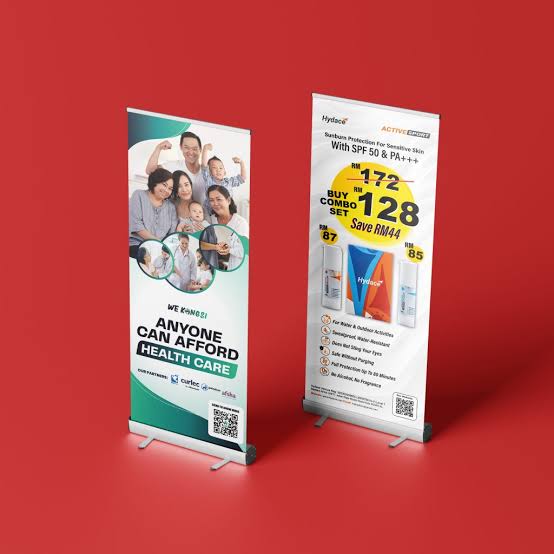
The most widely advertised roll up banner size in Kenya is 850 × 2000 mm, or 85 × 200 cm. It offers a practical balance of floor presence, portability and room for one clear marketing message. Kenyan suppliers also advertise wider 1000 × 2000 mm and 1200 × 2000 mm displays, while compact systems may use a shorter or narrower graphic.
E&M Creative’s published size guide lists 850 × 2000 mm, 1000 × 2000 mm and 1200 × 2000 mm systems. Imara Work Wear’s product specification also identifies 850 × 2000 mm as its standard format. These are market references, not a promise that every size or hardware type is currently stocked by Shammah Media.
Choose the format by location, audience, message and transport. Then obtain the exact template for the selected Shammah Media stand before creating final artwork. Two retractable systems with the same advertised face size may still use different leader sections, fixing methods, safe areas and total graphic heights.
You can use banner printing for current roll-up, X-banner and tear-drop options. Larger fixed displays may belong under large-format printing .
| Common advertised format | Where it can work well | What to confirm |
| 600 × 1700 mm | Tight reception areas and mobile use | Actual availability and readable content area |
| 850 × 2000 mm | Conferences, offices, exhibitions and retail | Selected stand template and visible area |
| 1000 × 2000 mm | Wider imagery or stronger floor presence | Booth width, transport and hardware footprint |
| 1200 × 2000 mm | Large indoor displays with adequate space | Stability, weight, transport and current stock |
Measurements that need separate confirmation
Graphic width
The printed width must match the stand and attachment system. Even a small difference can prevent correct installation or leave an unintended edge.
Finished graphic height
The production height may include material concealed inside the base or used for attachment. It is not always identical to the visible height.
Visible area
The audience sees less than the total printed graphic where part enters the base or sits behind hardware. Keep critical content inside the supplier’s stated safe area.
Overall standing dimensions
The complete unit includes the base, pole and any projection behind or in front. These dimensions matter for floor space, furniture, traffic and storage.
Packed dimensions and weight
Transport planning depends on the closed stand, pole sections, bag or case and total weight—not just graphic width.
Replacement-graphic specification
An existing base needs its precise model or a verified physical measurement. “Standard pull up banner size” is not enough to establish compatibility.
Choose size from the display setting
Reception and office use
Before booking, check available floor width, ceiling height, desk position and the direction visitors approach. A banner should not obstruct doors, queues, signs or accessibility routes.
Conference and exhibition use
Measure the allocated stand and consider neighbouring displays. Confirm organiser rules, booth boundaries and whether the banner must sit behind a table or within a shell scheme.
Stage and speaker background
A narrow roll-up may disappear in a wide camera frame. Map the stage, speaker position and video composition. Several coordinated units or another backdrop system may be more suitable.
Retail and promotional placement
Allow for customer flow, product displays and sight lines. The banner must remain stable and readable without becoming a trip or obstruction hazard.
Travel and mobile teams
When comparing options, consider packed length, weight, carrying protection and transport method. A display that fits the venue may still be impractical for frequent air or vehicle travel.
Prepare a roll-up banner size brief
- Intended venue and purpose
- Available floor width and ceiling height
- Normal viewing distance
- Main message and required amount of content
- Position relative to desks, stages or displays
- Indoor, sheltered or outdoor setting
- Frequency of reuse
- Existing stand or new complete system
- Exact hardware model for a replacement graphic
- Required quantity
- Packed-size and weight limits
- Transport and storage method
- Artwork status
- Event and delivery dates
- Collection or delivery location
A safe size-selection process
Measure the placement
You can record usable floor width, ceiling height, nearby furniture, power points, doors and walking routes. Photograph the space from the audience’s likely approach.
Define viewing conditions
Estimate how far away people will be, whether they are walking or seated, and how long they have to read. This determines message density and type scale as much as banner dimensions.
Select and verify the hardware
You can choose the available stand based on placement, quality, reuse and transport. Obtain its written graphic specification and template.
Design at the production dimensions
You can create artwork on the correct template with safe areas, bleed or other required allowances. Do not resize finished artwork blindly from another banner ratio.
Approve size and proof
Before booking, check the product reference, finished graphic, visible area, main message, logos, contact details and quantity. The approval should state whether the order includes a complete stand or replacement print.
Produce, assemble and inspect
The verified graphic is produced and installed in the intended hardware. Inspect alignment, retraction, stability, visible damage and order count before handover.
Request your roll up banner size quotation
Your written quotation will confirm the services, timing, deliverables and price for your project. Our current planning terms use a 14-day quotation validity period, a 50% booking deposit and one consolidated review round. Travel outside Nairobi is quoted separately, and digital working files are normally retained for 90 days. Your signed quotation takes priority if different terms are agreed.
Ask for the exact banner template
Send the venue measurements, intended placement, viewing distance, message and whether you need a complete stand or replacement graphic. We confirm the current product and provide its exact artwork specification before final design.
Width affects presence and content—not just price
A wider graphic creates room for imagery but needs more floor space and can be harder to transport. A narrow unit fits constrained areas but cannot carry unlimited text.
You can choose width from the composition. Several products or sponsor logos may require a wider display or, more often, fewer messages and a supporting brochure.
Do not make type smaller merely to preserve all supplied copy. The banner’s job is to attract, identify and direct. Detailed explanation can move to brochures , a staffed conversation or a maintained web page.
Height and sight lines
The main identity and headline should remain visible when the banner stands behind a table or among people. At the same time, the top must fit beneath the ceiling, booth structure or venue fixtures. Measure the actual site rather than assuming every indoor space provides the same clearance.
Place secondary details lower only if they remain useful at the expected distance. Content close to the base may be hidden by furniture or people and can be difficult to read. The verified safe area should also account for material entering the cassette.
For photographed or streamed events, test the banner in the expected camera frame. A display visible to an in-person guest may be cropped, out of focus or hidden behind a speaker on video.
Complete stand versus replacement graphic
If the existing model is unknown, provide photographs, labels and careful measurements or make the unit available for assessment. Never cut a new graphic based only on the old visible portion.
| Requirement | Information needed | Main risk |
| New complete roll-up | Available stand model, graphic size, base, pole, bag and warranty | Choosing by graphic size without checking footprint and transport |
| Replacement graphic | Exact existing model, attachment, total graphic dimensions and visible area | Assuming a similar width guarantees compatibility |
| Several coordinated units | Product consistency, artwork sequence, positions and quantities | Mixing stands, heights or colour treatments unintentionally |
Indoor and outdoor use
Most roll-up systems should not be assumed suitable outdoors. Wind can destabilise a tall narrow display, while uneven or wet surfaces create additional risk. A product’s outdoor suitability requires a specific manufacturer or supplier rating and a safe placement assessment.
Tell Shammah Media if the display will be outside, at an entrance or in a semi-sheltered area. A weighted or purpose-built alternative may be more appropriate, subject to verified availability. Never block emergency, accessibility or pedestrian routes to protect a display from weather.
Artwork dimensions and scaling
Design at the confirmed finished dimensions or an explicitly approved proportional scale. Record the scale in the file and adjust resolution, bleed, safe areas and finishing zones accordingly. A generic web template may use the wrong proportions.
Supply vector logos and original high-resolution images. Check image quality at output size. Fonts should be embedded or outlined according to production requirements, and critical text should remain editable until spelling and contact details are approved.
If an existing design must move to a different retractable banner size, reflow it. Scaling the whole page can make type too small, distort safe areas or leave the composition unbalanced.
Transport, storage and reuse
Before production, confirm whether the packed unit fits the intended transport, including its bag and pole sections. Label multiple units by artwork and venue.
Store the system in the verified orientation and environment, protected from moisture, crushing and uncontrolled heat. Follow product-specific instructions when extending or retracting the graphic. Do not allow the banner to snap back into the base.
For repeated campaigns, avoid dates or messages that expire too quickly. A replaceable graphic is useful only when compatible production and installation remain available; verify this before treating the stand as permanently reusable.
Ordering checklist
- Complete stand or replacement graphic
- Verified product or hardware model
- Total graphic width and height
- Visible area and safe zones
- Overall standing footprint and height
- Packed dimensions and weight
- Indoor or explicitly rated use environment
- Final artwork and version
- Quantity per design
- Bag, case or packaging
- Assembly and handling instructions
- Delivery destination and event deadline
Common size mistakes
Asking only for a standard size
The phrase does not guarantee compatibility. Confirm the exact stand specification.
Measuring only the visible old graphic
Material may extend into the base or attachment. Identify the model or assess the full system.
Ignoring furniture and foot traffic
The banner needs safe floor space, not only wall clearance.
Reusing artwork from another ratio
Blind scaling can damage type size, crop and safe areas. Rebuild the layout to the verified template.
Assuming indoor hardware is outdoor-safe
Outdoor use requires explicit product suitability and site assessment.
Forgetting packed size
Frequent users should evaluate transport and storage before choosing the display width.
Frequently asked questions
What is the standard roll up banner size?
In Kenya, 850 × 2000 mm is the most commonly advertised format. Treat it as a buying reference, then confirm the selected stand and use its verified graphic template before production.
Is pull up banner size the same as roll-up size?
The terms often describe retractable displays, but they do not guarantee identical dimensions or hardware. Confirm the model.
How do I measure a replacement graphic?
You can identify the stand model and manufacturer specification where possible. Visible width and height alone may omit attachment material concealed inside the base.
Which size works behind an exhibition table?
Measure the booth, table and sight lines, then choose an available stand whose important content remains visible. Review the actual template before design.
Can a roll-up banner be used outdoors?
Only when the exact product is rated and safely placed for those conditions. You should not assume a standard indoor cassette can tolerate wind.
What artwork size should I send?
You can use the exact template supplied for the selected stand, including its final dimensions, scale, bleed and safe-area requirements.
Can you print a graphic for my existing stand?
Possibly, after compatibility is verified. Send the model, labels and photographs or make the stand available for assessment.
Does a wider banner hold more information?
It provides more area but should still carry a concise hierarchy. A wider banner is not a reason to use small text or an unfocused message.
How do I transport a roll-up banner?
You can use the confirmed bag or case and follow the product’s handling guidance. Check packed size and weight against the transport method.
Confirm your roll-up banner size
Share the space, audience, message, transport needs and existing hardware through the Shammah Media contact page . Obtain the current stand specification before releasing artwork or ordering a replacement graphic.